








Chemistry Chaos
- Level: Foundation/Kinder to Year 6
- Duration: 60 or 90 minutes (90 minutes recommended)
- Numbers: Maximum of 30 students per workshop
- State: VIC & NSW
- Price
60 min: $450 per workshop
90 min: $560 per workshop
*Travel surcharge also applies based on location.
*Prices exclude GST.
*There is a minimum booking of 3 x 60 minute workshops or 2 x 90 minute workshops on the same day – or their cost equivalent.
"*" indicates required fields
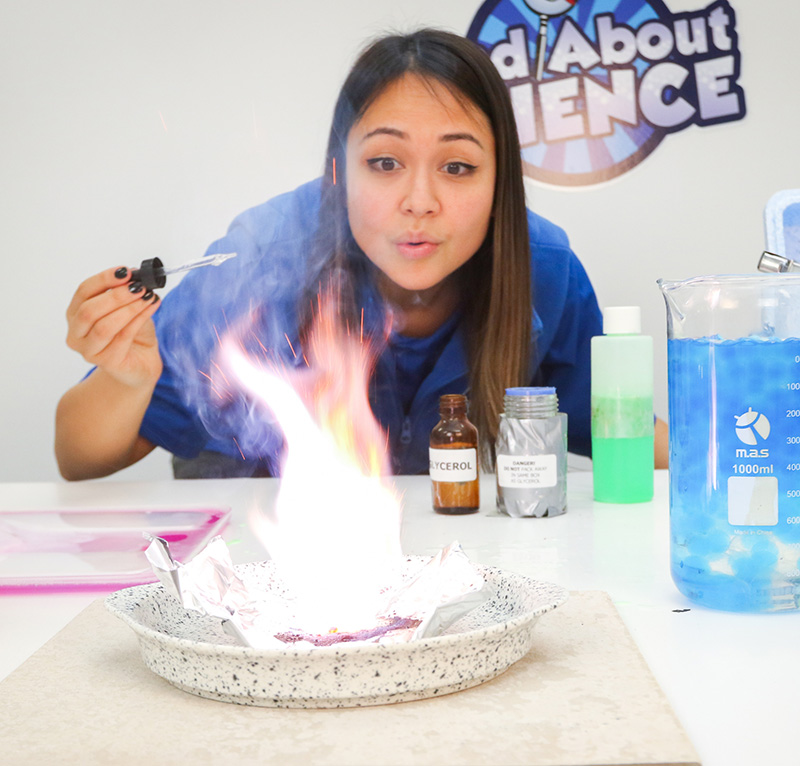
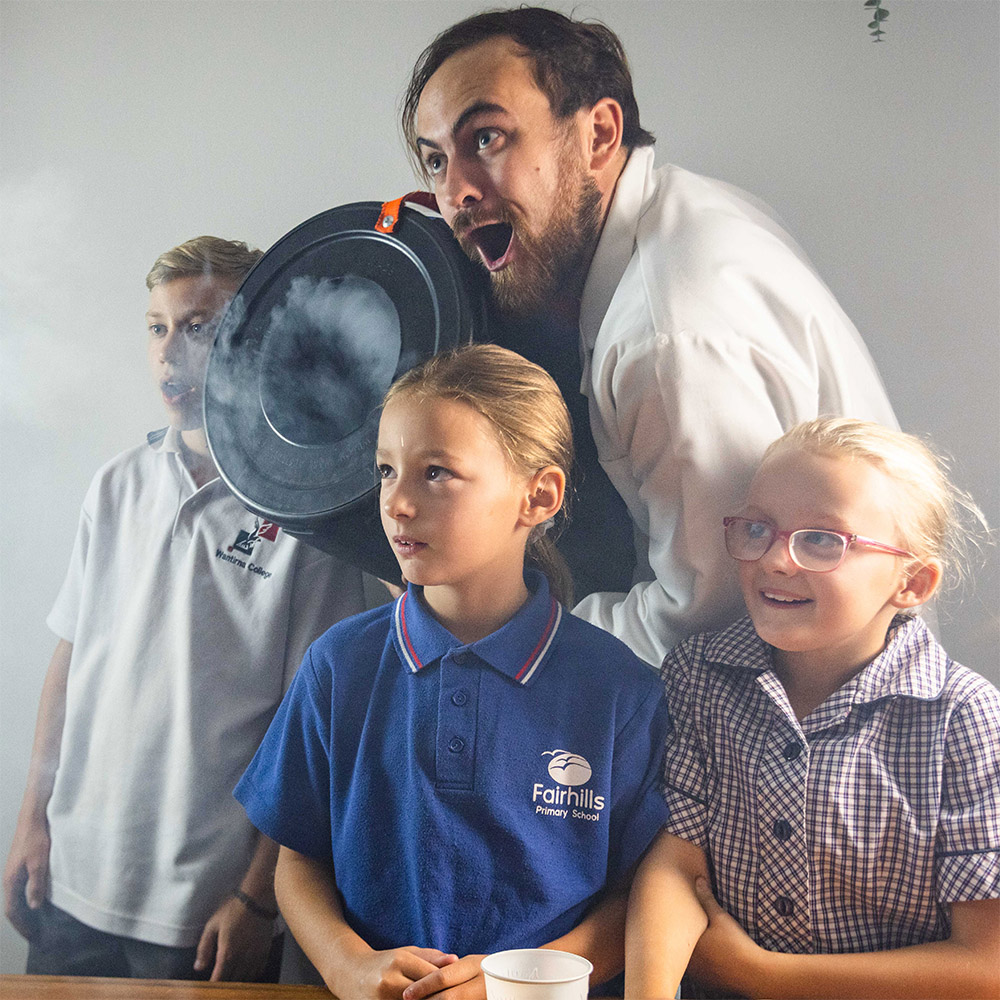
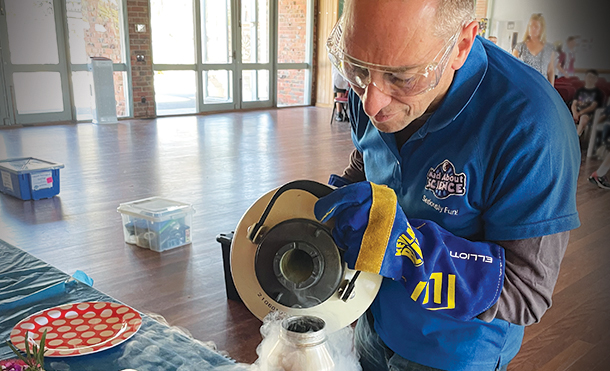
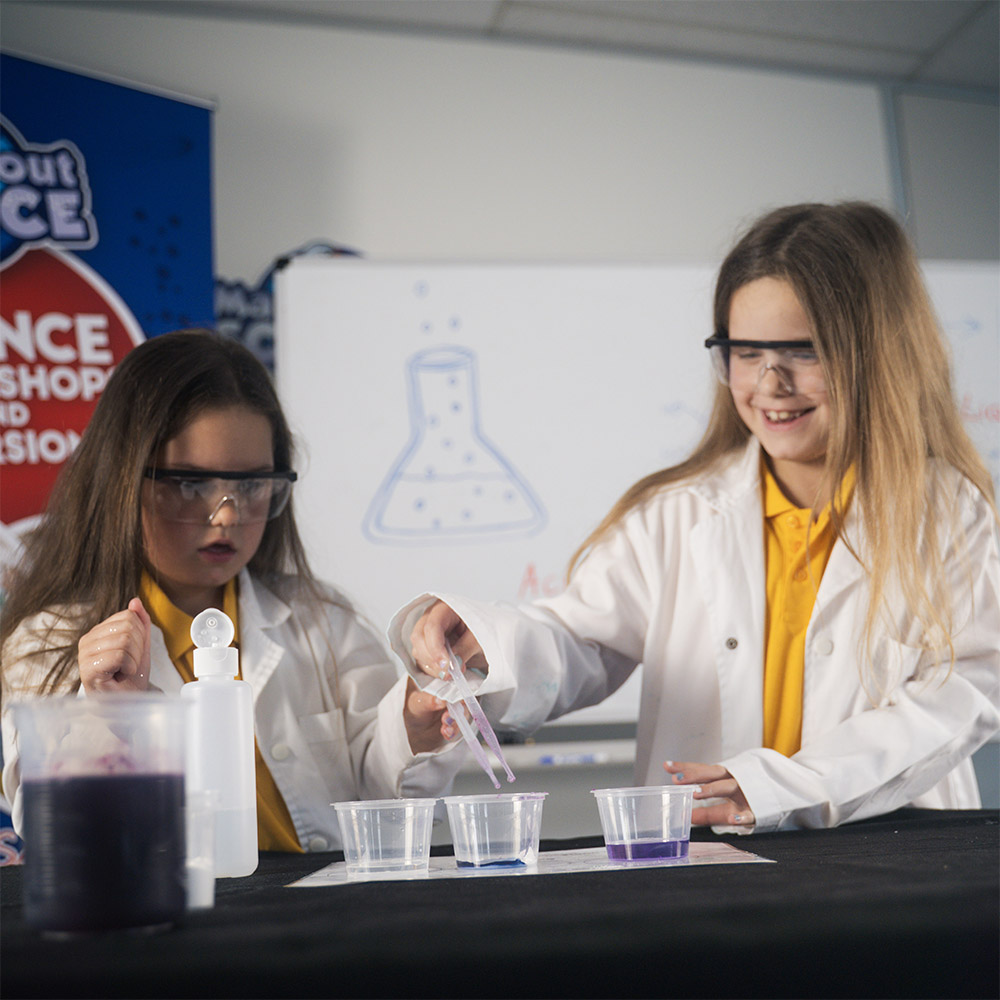
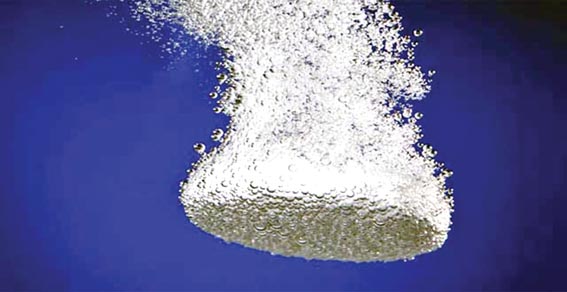
Experience the excitement of chemistry! Watch colour changes, smoke, fizz, and foam as you explore chemical reactions, physical changes, and the science behind the world around us.
Activities | Foundation/Kinder to Year 2
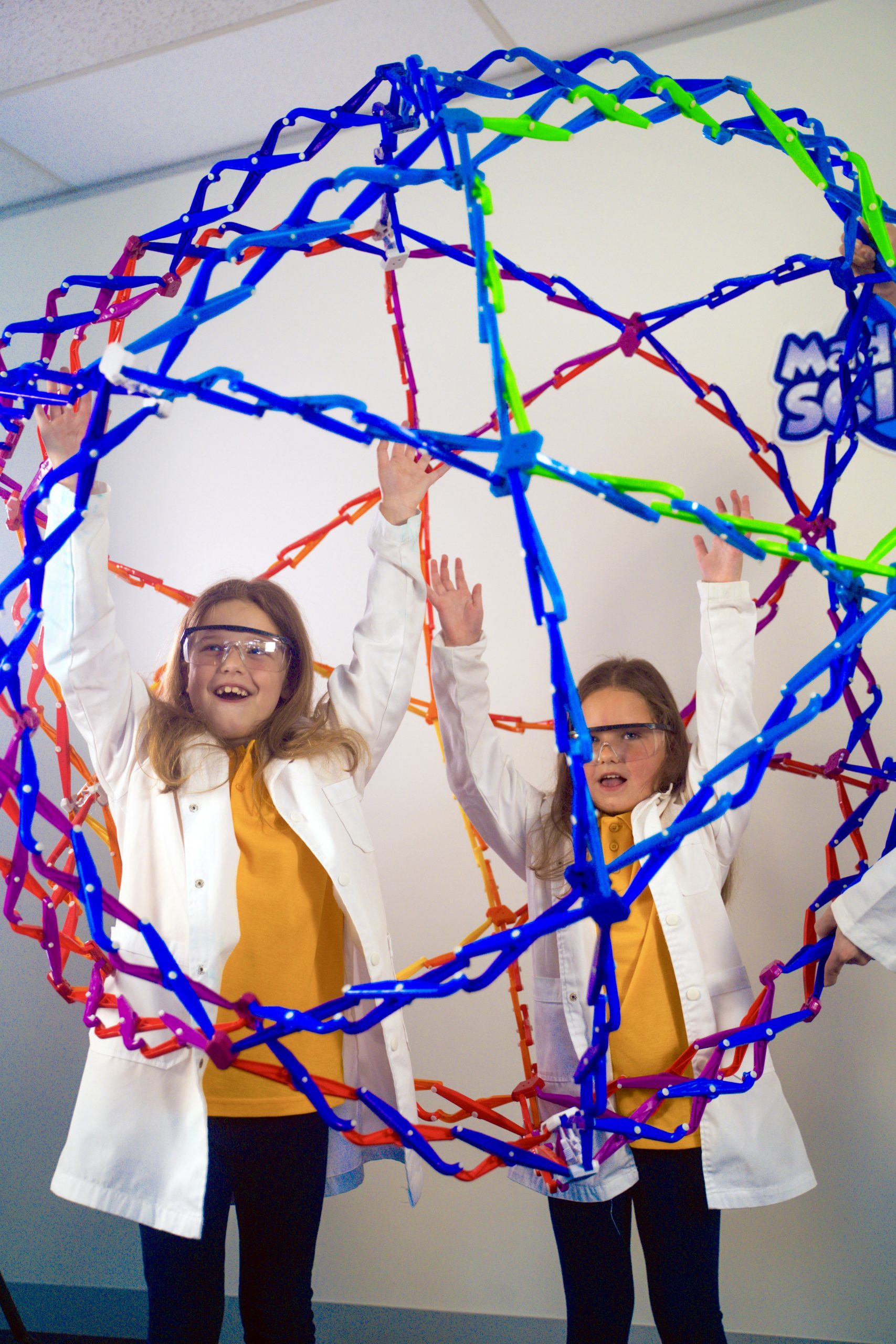
- Polymer material properties demonstration including an optical illusion with disappearing polymers.
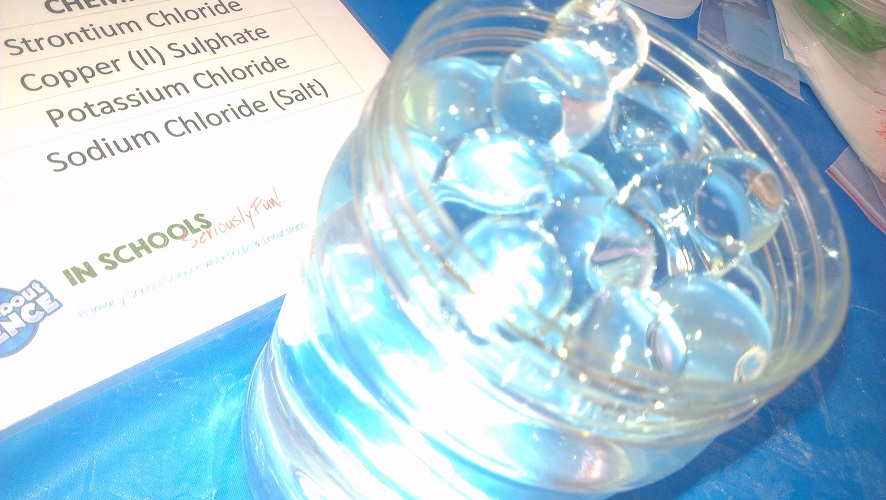
- Each student grows a polymer bead to keep.
- Small group exploration of a real-life polymer nappy piece, and how it responds to water.
- Demonstration of temporary physical change with an ocean bottle versus a powerful popping chemical change, including discussion of the new chemical made.
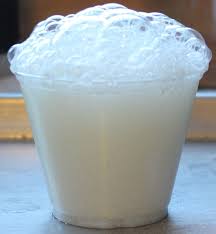
- Students mix baking soda and vinegar together resulting in an exciting endothermic chemical reaction.
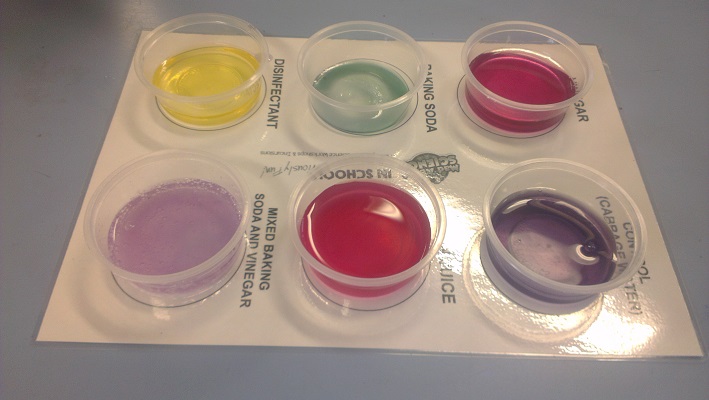
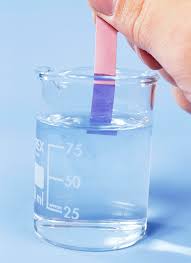
- Students use an indicator of cabbage water to identify acids and bases through colour changes.
90 minute workshops also include these activities:
- Students mix two chemicals to form a physical change and explore density changes.
- Demonstration of dishwashing liquid as an inhibitor to slow down chemical reactions.
Activities | Year 3 to Year 6
- Polymer material properties demonstration including an optical illusion with disappearing polymers.
- Each student grows a polymer bead to keep.
- Small group exploration of a real-life polymer nappy piece, and how it responds to water.
- Demonstration of temporary physical change with an ocean bottle versus a powerful popping chemical change, including discussion of the new chemical made.
- Students mix baking soda and vinegar together resulting in an exciting endothermic chemical reaction.
- Students use an indicator of cabbage water to identify acids and bases through colour changes.
90 minute workshops also include these activities:
- Students mix two chemicals to form a physical change and explore density changes.
- Demonstration of dishwashing liquid as an inhibitor to slow down chemical reactions.
- Students place nails in copper sulfate to demonstrate a slow chemical reaction.
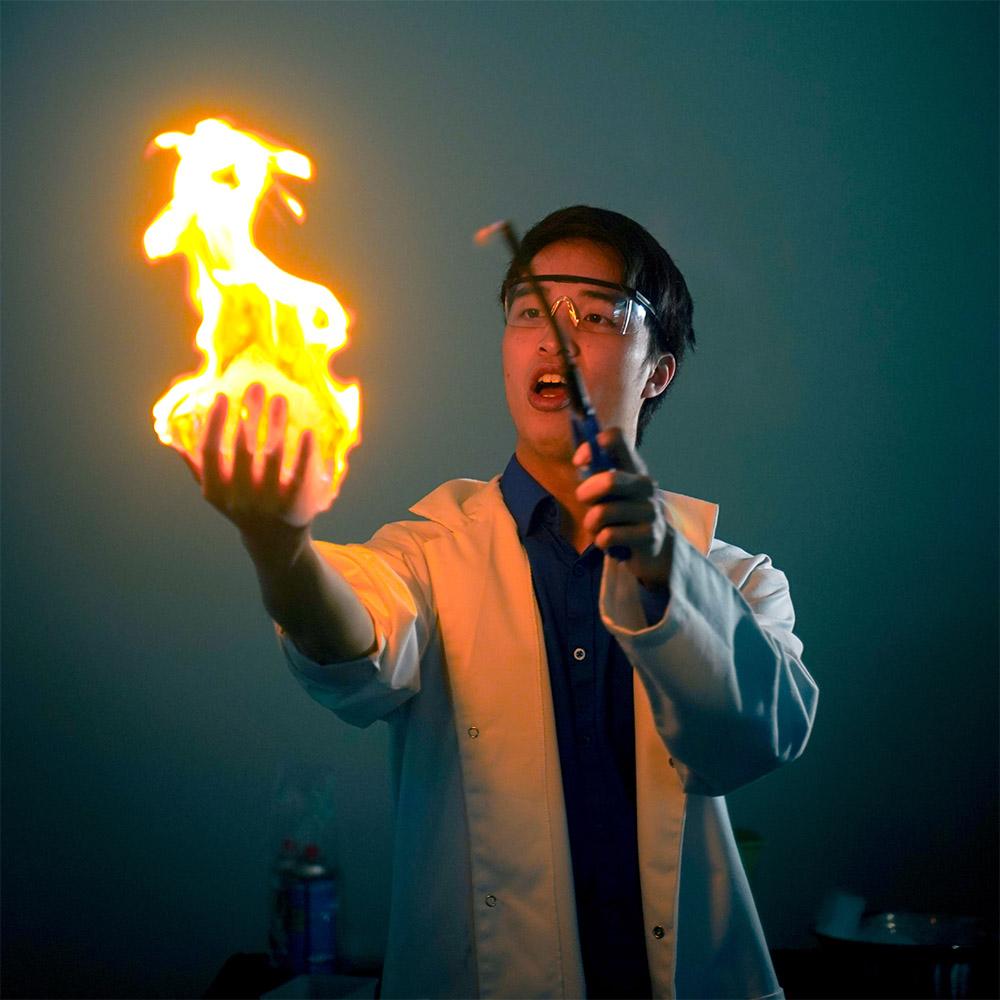
- Demonstration of burning different salts to identify salts by the colour of their flame.
Chemistry Chaos – Junior Version
Learning Outcomes | Prep/Kinder to Year 2
- Understand what a chemical is and recognise that everything in our world is made up of chemicals.
- Explore natural and man-made polymer chemicals, their special properties, and real-life uses of polymer materials.
- Distinguish between chemical reactions and physical changes, including identifying different reaction types such as endothermic and exothermic.
- Identify acids and bases using indicators, including cabbage water, and explore how combining acids and bases can alter pH and neutralise solutions.
- Develop essential laboratory skills including organisation, accuracy, measurement, correct use of equipment, and avoiding cross-contamination.
- Apply the scientific method and build appropriate scientific vocabulary.
Chemistry Chaos – Senior Version
Learning Outcomes | Year 3 to Year 6
- Understand what a chemical is and recognise that everything in our world is made up of chemicals.
- Explore natural and man-made polymer chemicals, their special properties, and real-life uses of polymer materials.
- Distinguish between chemical reactions and physical changes, including how to control the rate of a chemical reaction and identify different reaction types such as endothermic and exothermic.
- Identify acids and bases using indicators, including litmus paper, and explore how combining acids and bases can alter pH and neutralise solutions.
- Develop essential laboratory skills including organisation, accuracy, measurement, correct use of equipment, and avoiding cross-contamination.
Victorian Curriculum Links | Foundation to Year 2
- Objects can be made of one or more different materials; these materials have observable properties VC2S2U04
- Materials can be combined in a variety of ways for particular purposes; the properties of objects and mixtures can differ from the properties of the materials from which they are made VC2S2U05
- Materials can be changed physically by different actions without changing their material composition, including by bending, twisting, stretching, crushing, squashing and breaking into smaller pieces VC2S2U06
- Experiences can be used as a basis for posing questions to explore observed patterns and relationships, and to make predictions VC2S2I01
- Scientific questions and predictions can be investigated safely by following procedures that have sequenced steps VC2S2I02
Victorian Curriculum Links | Year 3 to Year 6
- Solids, liquids and gases have observable properties; adding or removing heat energy leads to a change of state between solids, liquids and gases VC2S4U04
- The properties of natural and made materials, including fibres, metals, glass and plastics, influence their use and re-use VC2S4U05
- Observations can be used as a basis for posing questions to identify patterns and relationships, and to predict the outcomes of investigations VC2S4I01
- The observable properties of matter (solids, liquids and gases) can be explained by modelling the motion and arrangement of their particles; mixtures (including solutions) can be formed by combining 2 or more different substances VC2S6U03
- Changes to substances may be reversible, in which case the substance may be recovered, or irreversible, in which case new substances are formed; for most substances a change of state or dissolving in water is reversible, while irreversible changes include cooking and rusting VC2S6U04
- Investigable questions and reasoned predictions can be used in guiding investigations to identify patterns and test relationships VC2S6I01
NSW Curriculum Links | Foundation to Year 2
- Identifies that objects are made of materials that have observable properties (STe-4MW-ST)
- Identifies that materials can be changed or combined (ST1-6MW-S)
- Describes how the properties of materials determine their use (ST1-7MW-T)
NSW Curriculum Links | Year 3 to Year 6
- Investigates the suitability of natural and processed materials for a range of purposes (ST2-7MW-T)
- Explains the effect of heat on the properties and behaviour of materials (ST3-6MW-S)
- Explains how the properties of materials determine their use for a range of purposes (ST3-7MW-T)
- Questions, plans and conducts scientific investigations; collects, summarises and communicates data using scientific representations (ST2-1WS-S)
Australian Curriculum Links
- Recognise that objects can be composed of different materials and describe the observable properties of those materials (AC9SFU03)
- Explore the ways people make and use observations and questions to learn about the natural world (AC9SFH01)
- Pose questions and make predictions based on experiences (AC9SFI01)
- Compare observations with predictions and others’ observations, consider fairness, and identify further questions with guidance (AC9S1I05, AC9S2I05)
- Pose questions to explore observed patterns and relationships and make predictions (AC9S3I01, AC9S4I01)
- Explain observable properties of solids, liquids and gases using particle models (AC9S5U04)
- Investigate how scientific knowledge is used to identify problems and make decisions (AC9S5H02, AC9S6H02)
- Pose investigable questions to identify patterns and test relationships (AC9S5I01, AC9S6I01)
- Examine the properties of natural and made materials and how these influence their use (AC9S4U04)