











Water & The Environment
- Level: Foundation/Kinder to Year 4
- Duration: 60 or 90 minutes (90 minutes recommended)
- Numbers: Maximum of 30 students per workshop
- State: VIC & NSW
- Price
60 min: $450 per workshop
90 min: $560 per workshop
*Travel surcharge also applies based on location.
*Prices exclude GST.
*There is a minimum booking of 3 x 60 minute workshops or 2 x 90 minute workshops on the same day – or their cost equivalent.
"*" indicates required fields
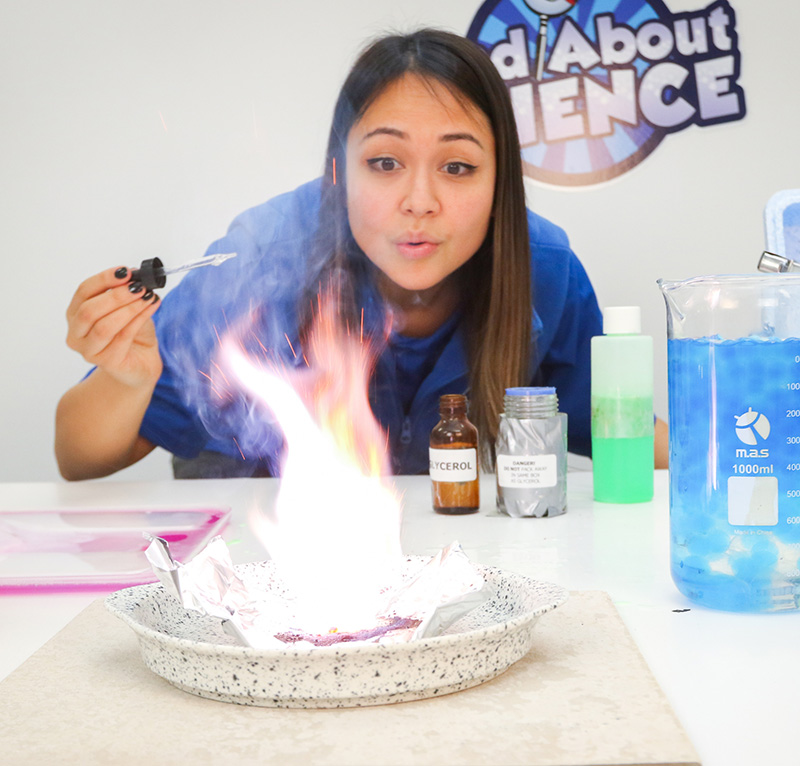
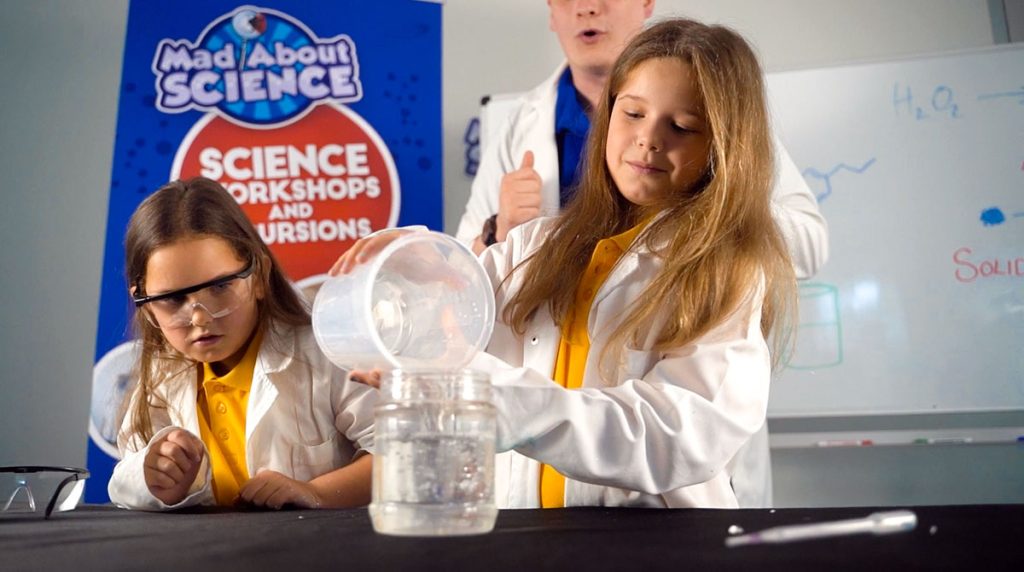
Water is essential to life—and full of surprises. In this hands-on workshop, students explore the unique properties of water, discover why it’s “sticky,” and design a simple water filter while learning why this precious resource matters.
Activities
- Students use basic laboratory equipment to make a simple model of the water cycle in small groups.
- Students clean up a simulated oil spill with oil-absorbing pad.
- Group exploration of capillary action.
- Each student uses pipettes and water on a sugar landscape model.
- Demonstration of the properties of water including surface tension, cohesion, and transparency.
90-minute workshops also include these activities:
- Students use an indicator solution to test for pollution in water samples.
- Students are set a challenge to make a paperclip float using surface tension.
Learning Outcomes
- Students will explore Bernouli’s principle and understand the basics of flight.
- Fire requires three things; oxygen, heat energy, and fuel.
- Chemical reactions create new chemicals, such as gas, and are often irreversible.
- Some chemical reactions yield a lot of energy. These are called exothermic reactions.
- Students will be able to identify different push and pull forces.
- Static electricity is when electrons build up and stay in one place, like lighting or jumping on a trampoline.
- Current electricity is when electrons flow in a circuit.
Victorian Curriculum Links
- Scientific knowledge is based on observations of the natural world using the senses, and scientific tools and instruments VC2S2H01
- Taking care of Earth’s water, land and air involves consideration of reducing, re-using and recycling materials to conserve Earth’s resources VC2S2U09
- Scientific questions and predictions can be investigated safely by following procedures that have sequenced steps VC2S2I02
- Data from observations obtained through scientific inquiry can be used to develop explanations of natural phenomena VC2S4H01
- Water is an important Earth resource that originates from various sources; water cycles through the environment by moving through the sky, landscape and ocean, and involves processes including precipitation, evaporation, transpiration, condensation, melting, freezing, crystallisation, infiltration and run-off VC2S4U07
- Weather events and climate have impacts on the land, air, water and living things; human activity can affect climate VC2S4U08
NSW Curriculum Links
- Investigates regular changes caused by interactions between the Earth and the Sun, and changes to the Earth’s surface (ST2-10ES-S)
- Questions, plans and conducts scientific investigations, collects and summarises data and communicates using scientific representations (ST2-1WS-S)
- Identifies that materials can be changed or combined (ST1-6MW-S)
- Describes how the properties of materials determine their use (ST1-7MW-T)
Australian Curriculum Links
- Science knowledge helps people to understand the effects of their actions (ACSHE051)
- Earth’s resources are used in a variety of ways (ACSSU032)
- Earth’s surface changes over time as a result of natural processes and human activity (ACSSU075)
- Participate in guided investigations, including making observations using the senses, to explore and answer questions (ACSIS025)