
Light & Sound
- Level: Foundation/Kinder to Year 3
- Duration: 60 or 90 minutes (90 minutes recommended)
- Numbers: Maximum of 30 students per workshop
- State: VIC & NSW
- Price
60 min: $450 per workshop
90 min: $560 per workshop
*Travel surcharge also applies based on location.
*Prices exclude GST.
*There is a minimum booking of 3 x 60 minute workshops or 2 x 90 minute workshops on the same day – or their cost equivalent.
"*" indicates required fields
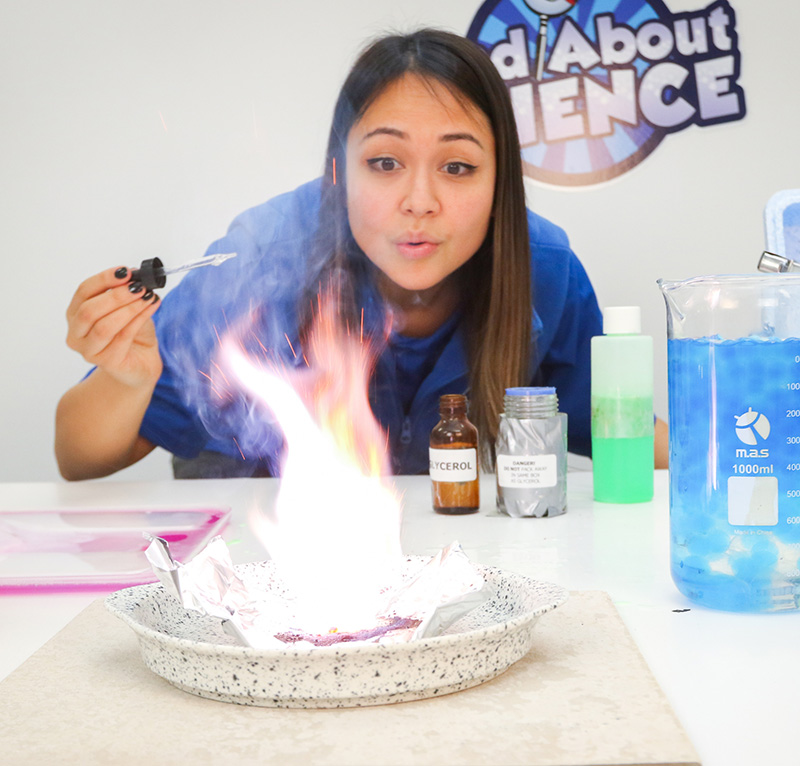
Make some waves, and colour your classroom with rainbows. Using a sensory approach, learn all about the properties and transmission of light and sound energy.
Activities
- Students experience the disorientation of being deprived of sight.
- Small group investigation into materials that allow sound to pass through them, and materials that allow light to pass through them.
- Engaging demonstration of the differences between light waves and sound waves, including the concepts of reflection and echoes.
- Students observe the refraction of white light into a spectrum of colours through a prism.
- Demonstration of how lenses can be used to form an image, similar to the eye and a camera lens.
- Students explore a range of optical instruments that use lenses and mirrors to change the path of light.
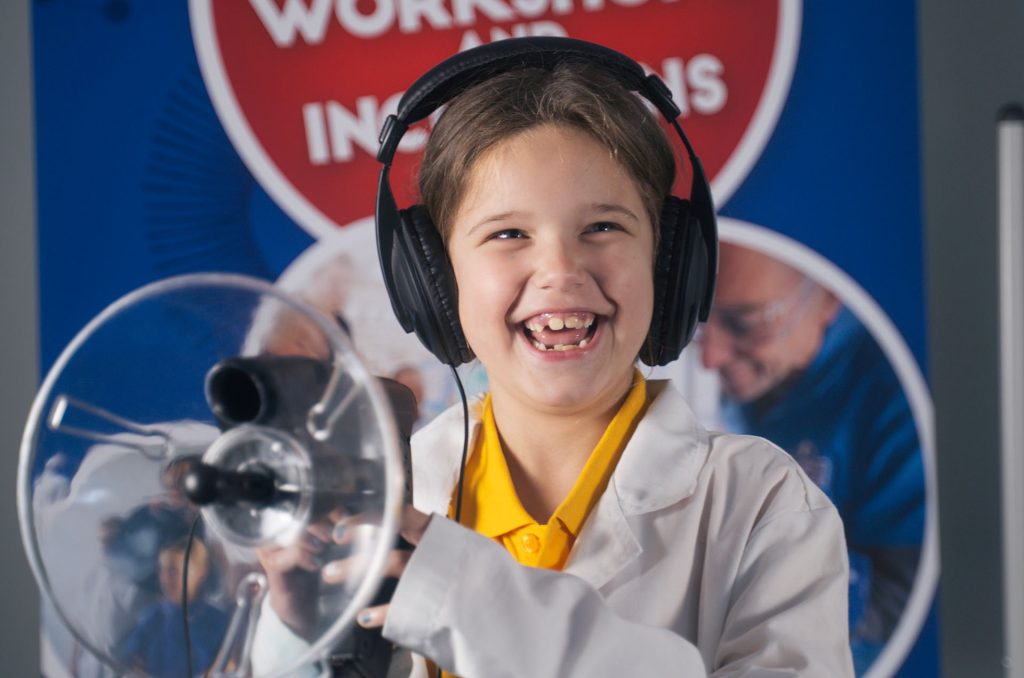
- Students experiment with transferring and transforming vibrations as sound energy.
90 minute workshop also includes the following:
- Transforming light demonstration.
- Screaming balloon activity.
Learning Outcomes
- Understand that we need a source of light to see, and that our eyes detect light while our ears detect sound.
- Explore how sound energy can travel through different materials, and that some materials transfer sound better than others.
- Investigate how different materials interact with light, including transparent, translucent and opaque materials.
- Understand that light can travel through the vacuum of space, but sound cannot.
- Recognise that both light and sound travel in waves, but that the waves have different properties.
- Explore how visible light (white light) is made up of a spectrum of colours, and how prisms and raindrops separate white light into a rainbow.
- Investigate how lenses bend light through refraction and are used to form images and help us see distant objects.
- Understand that light energy and sound energy can be transformed into other forms of energy, such as electrical energy.
Victorian Curriculum Links
- Scientific knowledge is based on observations of the natural world using the senses, and scientific tools and instruments VC2S2H01
- Science is used by people in their daily lives, including asking questions and using patterns from observations of the world around them to make scientific predictions VC2S2H02
- Sound can make materials vibrate and vibrating materials can make sound; different actions can be used to produce sounds of varying pitch and volume VC2S2U12
- Scientific questions and predictions can be investigated safely by following procedures that have sequenced steps VC2S2I02
NSW Curriculum Links
- Describes common forms of energy and explores some characteristics of sound energy (ST1-8PW-S)
- Questions, plans and conducts scientific investigations, collects and summarises data and communicates using scientific representations (ST2-1WS-S)
- Describes the characteristics and effects of common forms of energy, such as light and heat (ST2-8PW-ST)
- Plans and uses materials, tools and equipment to develop solutions for a need or opportunity (ST3-2DP-T)
- Investigates how forces and energy are used in products (ST1-9PW-ST)
- Explains how the properties of materials determine their use for a range of purposes (ST3-7MW-T)
Australian Curriculum Links
- Light and sound are produced by a range of sources and can be sensed (ACSSU020)
- Light from a source forms shadows and can be absorbed, reflected and refracted (ACSSU080)
- Electrical energy can be transferred and transformed in electrical circuits and can be generated from a range of sources (ACSSU097)
- Participate in guided investigations, including making observations using the senses, to explore and answer questions (ACSIS025)