











Earth & The Milky Way
- Level: Foundation/Kinder to Year 6
- Duration: 60 or 90 minutes (90 minutes recommended)
- Numbers: Maximum of 30 students per workshop
- State: VIC & NSW
- Price
60 min: $450 per workshop
90 min: $560 per workshop
*Travel surcharge also applies based on location.
*Prices exclude GST.
*There is a minimum booking of 3 x 60 minute workshops or 2 x 90 minute workshops on the same day – or their cost equivalent.
"*" indicates required fields
Space is a vacuum but it is far from empty. During this fascinating workshop, you’ll launch into space and explore planets, moons, stars and galaxies. Follow in the footsteps of the great astronomers as you probe the mystery, scale and earth’s place in the universe.
Activities | Foundation/Kinder to Year 2
- Use Stellarium to simulate the night sky and learn about how objects change each night.
- Groups create a scale model of planets in the Solar System comparing size and distance.
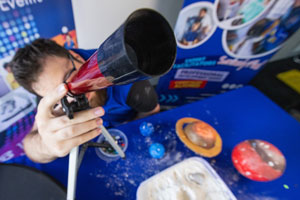
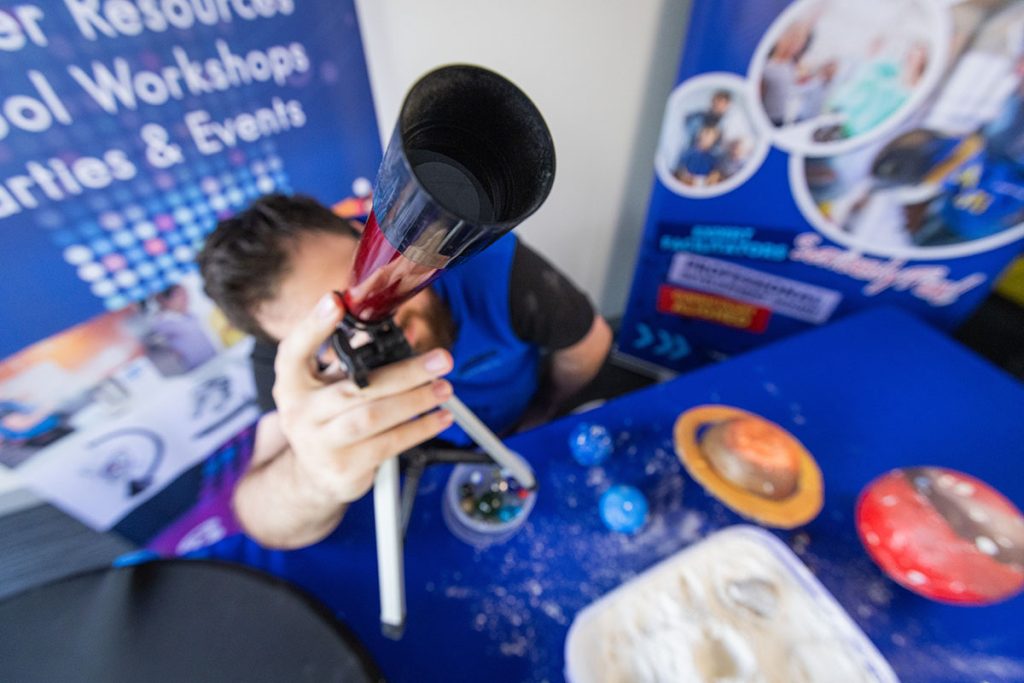
- Students explore tables filled with hands-on space related activities, learning about galaxies, stars, space exploration, seasons and moons.
90 minute workshop also includes these activities:
- Demonstration of Newton’s Third Law of Motion using a balloon rocket.
- Students use a chemical reaction to launch a test tube rocket to show how the build up of pressure creates thrust.
Activities | Year 3 to Year 6
- Use Stellarium to simulate the night sky and learn about how objects change each night.
- Groups create a scale model of planets in the Solar System.
- Demonstration and activity to explore how mass affects gravitational pull and curves space-time.
- Using a rocket, show the effect of Newton’s Third Law of Motion.
- Rocket launch: students use a chemical reaction to launch a test tube rocket to show how the build up of pressure creates thrust.
90 minute workshop also includes these activities:
- Spacecraft docking: students coordinate to dock with a space station in orbit.
- Moving in empty space? See how gyroscopes are used to turn and keep spacecraft stable.
- Watch black glittery elephant toothpaste expand like the early Big Bang.
Learning Outcomes
- The names, number, and order of the planets from the Sun.
- Exploring the sizes of planets and their distance from the Sun, to scale.
- Planets rotate (turn, spin) on their axes, with one full rotation equalling one day (24 hours on Earth).
- In addition to rotating, planets also revolve around the Sun, which causes the seasons.
- To launch into space, a rocket must generate a force called thrust to overcome Earth’s gravity.
- The surfaces of other planets and moons can be very different from Earth’s.
- Space is a vacuum—there is no air.
- Humans explore space using rovers and satellites.
Victorian Curriculum Links | Foundation to Year 2
- Daily and seasonal changes in the weather and the environment can be observed and affect decisions made in everyday life VC2S2U07
- Earth is one of 8 planets in our solar system; observing the sky reveals patterns in the changing positions of the Sun, Moon, planets and stars VC2S2U08
- Scientific knowledge is based on observations of the natural world using the senses, and scientific tools and instruments VC2S2H01
- Science is used by people in their daily lives, including asking questions and using patterns from observations of the world around them to make scientific predictions VC2S2H02
- The way objects move depends on a variety of factors including their size, shape and material VC2S2U10
- Data and information can be sorted and ordered using provided tables and organisers, and visual or physical models, to show simple patterns VC2S2I04
Victorian Curriculum Links | Year 3 to Year 6
- Scientific knowledge changes over time, often resulting from collaboration or by building on the work of others, and leads to advances in science VC2S6H01
- The force of gravity keeps Earth and other planets in the solar system in orbit around the Sun; cyclic observable phenomena, including variable day and night length, can be related to Earth’s tilt, rotation on its axis and revolution around the Sun VC2S6U07
- Forces, including frictional, gravitational, electrostatic and magnetic, can be exerted by one object on another through direct contact or from a distance and affect the motion (speed and direction) of objects VC2S4U10
- Data and information can be organised and represented to identify patterns and simple relationships by constructing tables, graphs and visual or physical models VC2S4I04
- Data and information can be organised and processed to show patterns, trends and relationships by constructing representations including tables, graphs and visual or physical models VC2S6I04
NSW Curriculum Links | Kinder to Stage 1
- Recognises observable changes occurring in the sky and on the land and identifies Earth’s resources (ST1-10ES-S)
- Observes, questions and collects data to communicate ideas (STE-1WS-S)
NSW Links | Stage 2 to Stage 3
- Describes how contact and non-contact forces affect an object’s motion (ST2-9PW-ST)
- Investigates regular changes caused by interactions between the Earth and the Sun, and changes to the Earth’s surface (ST2-10ES-S)
- Investigates the effects of increasing or decreasing the strength of a specific contact or non-contact force (ST3-9PW-ST)
- Explains regular events in the solar system and geological events on the Earth’s surface (ST3-10ES-S)
Australian Curriculum Links
- Describe how objects move and how factors including their size, shape or material influence their movement (AC9SFU02)
- Explore the ways people make and use observations and questions to learn about the natural world (AC9SFH01)
- Pose questions and make predictions based on experiences (AC9SFI01)
- Describe pushes and pulls in terms of strength and direction and predict the effect of these forces on objects’ motion and shape (AC9S1U03)
- Recognise Earth is a planet in the solar system and identify patterns in the changing position of the Sun, Moon, planets and stars in the sky (AC9S2U01)
- Compare observations with predictions and others’ observations, consider if investigations are fair and identify further questions (AC9S1I05, AC9S2I05, AC9S3I05, AC9S4I05)
- Identify how forces can be exerted by one object on another and investigate the effect of frictional, gravitational and magnetic forces on the motion of objects (AC9S4U03)
- Examine how people use data to develop scientific explanations (AC9S3H01, AC9S4H01)
- Consider how people use scientific explanations to meet a need or solve a problem (AC9S3H02, AC9S4H02)