









- Level: Year 3 to Year 6
- Duration: 60 or 90 minutes (90 minutes recommended)
- Numbers: Maximum of 30 students per workshop
- State: VIC & NSW
- Price
60 min: $450 per workshop
90 min: $560 per workshop
*Travel surcharge also applies based on location.
*Prices exclude GST.
*There is a minimum booking of 3 x 60 minute workshops or 2 x 90 minute workshops on the same day – or their cost equivalent.
"*" indicates required fields
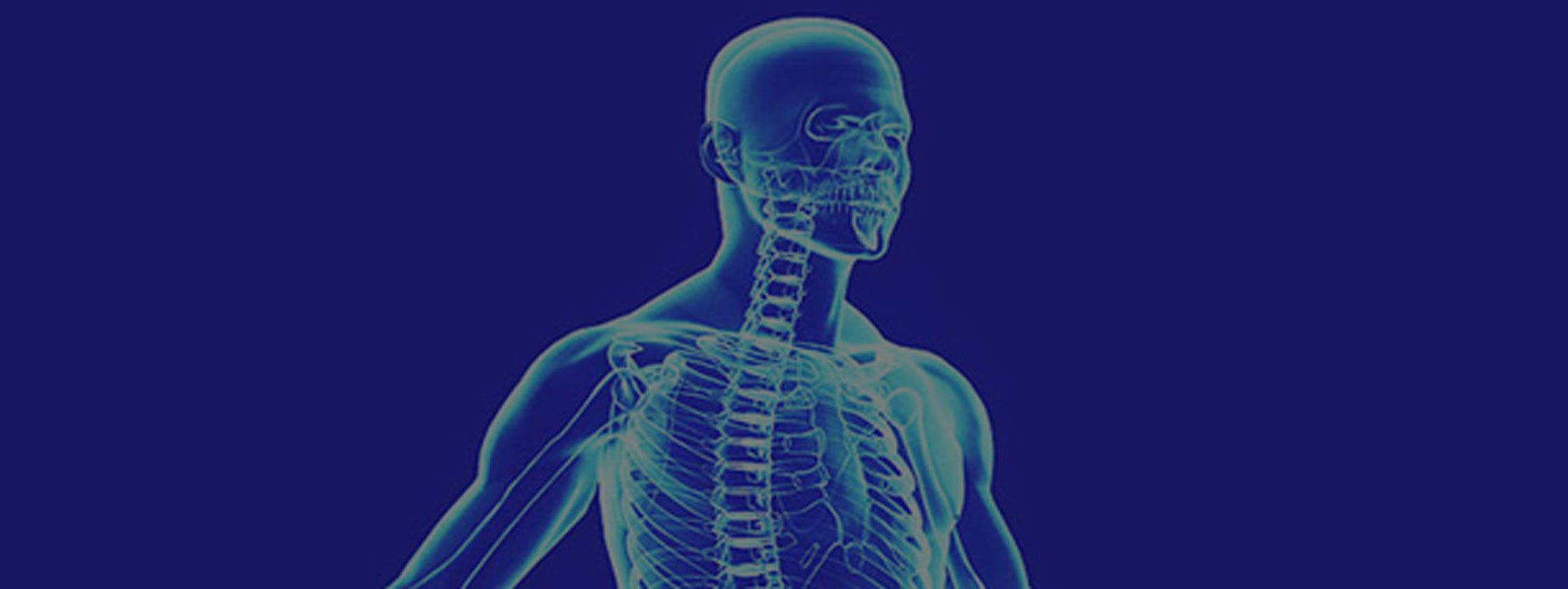
Take a journey through the human body, and explore its parts and systems. Perform chemical experiments to understand digestion, think quick and test reaction speeds, use stethoscopes to listen to the rhythmic beat of your heart. Learn how we are all connected, and made of the stuff of stars!
Activities
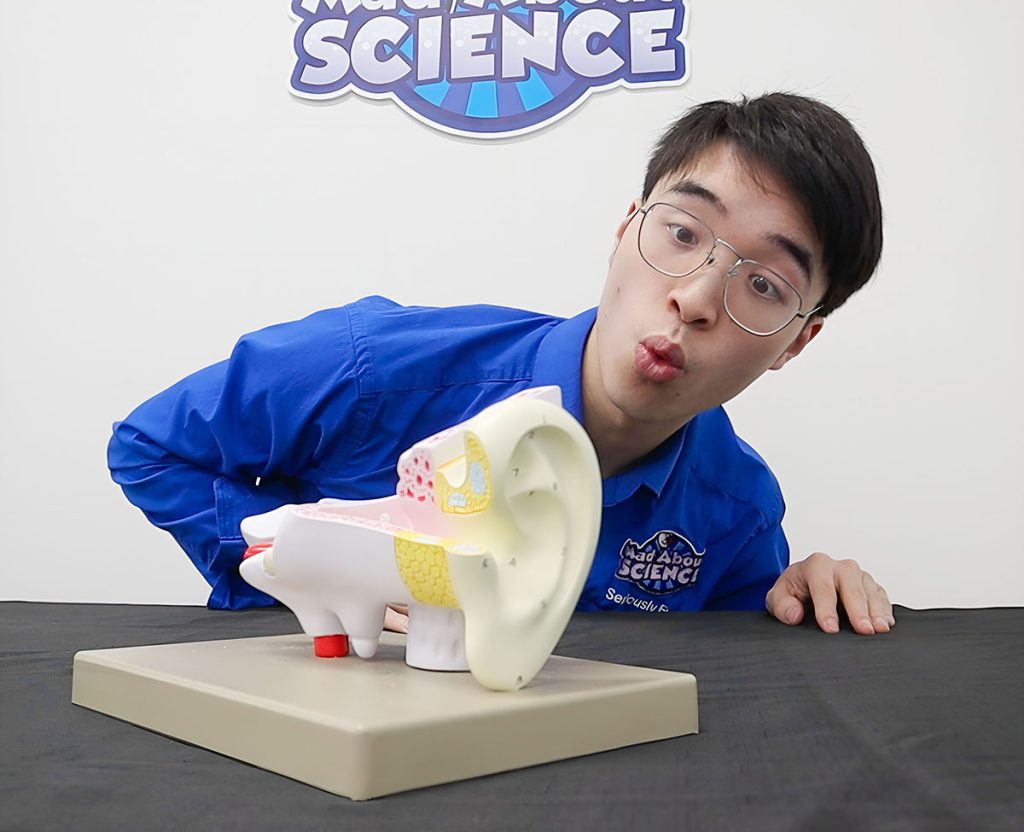
- The human body is introduced as an amazing machine, with students exploring major organs using a large anatomical model.
- Students investigate how lenses focus light through refraction and connect this to how the human eye works.
- Each student grows their own synthetic eyeball lens to take home and explores how it refracts light.
- In small groups, students test and compare the acidity of water, gastric juice, and antacid, then observe the effect of adding antacid to gastric juice.
- Students use stethoscopes to listen to their heartbeat and learn how to measure their pulse.
- Students investigate how physical activity affects heart rate through simple exercise experiments.
- Students measure their reaction time and explore the steps involved in detecting and responding to a stimulus.
- Students take part in a whole-class activity that models how electrical signals travel through the nervous system.
90 minute workshop also includes the following:
- Demonstration of the respiratory system.
Learning Outcomes
- The human body is a complex, coordinated machine, made up of different systems (e.g., circulatory, respiratory, digestive and nervous systems) that work together. The simplest building block in the body is called a cell. Groups of similar cells are called tissues and tissues form organs (such as the heart, lungs, kidneys, liver and brain). Groups of organs that have a common purpose make up a system.
- The eye contains a lens that focuses light on the retina to form an upside-down image. The brain turns the image the right way up.
- The digestive system breaks down the food we eat for energy, growth and repair.
- The stomach contains strong acid and gastric juice to chemically break down food. Antacids contain a type of chemical called a base that neutralises excess stomach acid.
- The circulatory system consists of the heart and the blood vessels. The blood delivers food and oxygen to every cell of the body, and carries away carbon dioxide and waste products.
- Exercising increases the heartbeat, as the heart works harder to circulate oxygen and nutrients.
- The brain, spinal cord and nerve cells make up the nervous system. The brain is the control centre of the body, sending messages via the nerves to all parts of the body.
- The body is made up of many different elements – the same elements that make up everything else in the Universe. Many of these elements in the body are charged particles, so the body can conduct electricity.
Victorian Curriculum Links
- Observations can be used as a basis for posing questions to identify patterns and relationships, and to predict the outcomes of investigations VC2S4I01
- Observations, including formal measurements, can be made and recorded by following procedures to use familiar scaled instruments and digital tools as appropriate VC2S4I03
- Data and information can be organised and represented to identify patterns and simple relationships by constructing tables, graphs and visual or physical models VC2S4I04
- Investigable questions and reasoned predictions can be used in guiding investigations to identify patterns and test relationships VC2S6I01
- Equipment can be used to observe, generate, measure and record data with reasonable precision for repeated measurements, using digital tools as appropriate VC2S6I03
- Data and information can be organised and processed to show patterns, trends and relationships by constructing representations including tables, graphs and visual or physical models VC2S6I04
NSW Curriculum Links
- Compares features and characteristics of living and non-living things (ST2-4LW-S)
- Examines how the environment affects the growth, survival and adaptation of living things (ST3-4LW-S)
- Plans and uses materials, tools and equipment to develop solutions for a need or opportunity (ST3-2DP-T)
- Describes how digital systems represent and transmit data (ST2-11DI-T)
Australian Curriculum Links
- Compare characteristics of living and non-living things and examine the differences between the life cycles of plants and animals (AC9S3U01)
- Examine how people use data to develop scientific explanations (AC9S3H01, AC9S4H01)
- Consider how people use scientific explanations to meet a need or solve a problem (AC9S3H02, AC9S4H02)
- Pose questions to explore observed patterns and relationships and make predictions based on observations (AC9S3I01, AC9S4I01)
- Compare findings with those of others, consider if investigations were fair, identify questions for further investigation and draw conclusions (AC9S3I05, AC9S4I05)