











Forensic Detective
- Level: Year 3 to Year 6
- Duration: 90 minutes
- Numbers: Maximum of 30 students per workshop
- State: VIC & NSW
- Price: $560 per 90 minute workshop
*Travel surcharge also applies based on location.
*Prices exclude GST.
*There is a minimum booking of 2 x 90 minute workshops or 3 x 60 minute workshops on the same day – or their cost equivalent.
"*" indicates required fields
Can you crack the case and catch the thief? Use real life forensic science techniques- pH tests, handwriting analysis, fingerprint dusting and more to pin-point the culprit.
Activities
- Students are presented with a fictitious crime scenario, four suspects, and evidence found at the scene. Students complete a series of forensic analysis tasks and use their results to identify the guilty suspect.
- Students produce suspect profiles based on information gathered by detectives and discuss possible motives for committing the crime.
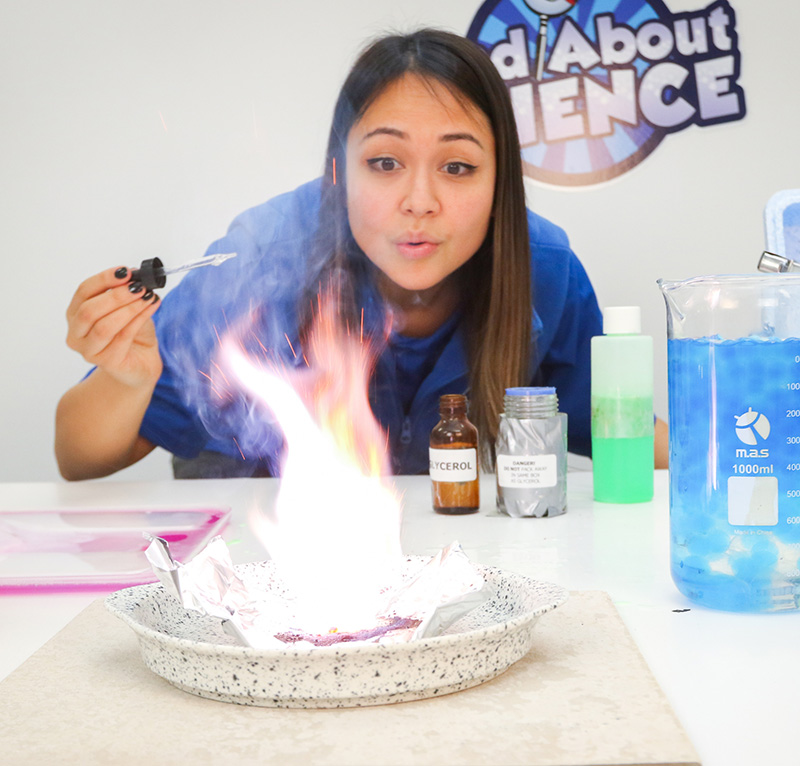
- Students perform a range of tests and record observations to determine the nature of a powder found at the crime scene.
- Students record all their findings and data on a sheet for consideration.
- Students use chromatography to determine which pen was used to write a note found at the crime scene.
- Students examine suspects’ shoes to determine who left their footprint at the crime scene.
- Using a black light, students learn about fingerprint details to identify the fingerprints left at the crime scene.
- Students learn about luminol and how it can be used to find bodily fluids.
- Putting all the evidence together, students make logical arguments for who they believe committed the crime.
Learning Outcomes
- Understand that forensic scientists assist police in solving crimes.
- Explore how forensic scientists use a range of scientific techniques to analyse evidence found at crime scenes.
- Investigate common forensic techniques including fingerprint and footprint analysis, ink chromatography, blood analysis, and testing chemical properties such as pH, solubility and acid–base reactions.
- Understand that results from laboratory tests and forensic analysis can be used as evidence in a court case.
- Apply logical reasoning to determine the most likely scenario when presented with multiple possibilities.
Victorian Curriculum Links
- Scientific knowledge, skills and data can be used by people to explain how they will meet a need or solve a problem VC2S4H02
- Observations can be used as a basis for posing questions to identify patterns and relationships, and to predict the outcomes of investigations VC2S4I01
- Scientific investigations to answer questions or test predictions can be planned and conducted using provided scaffolds, including identifying the attributes of fair tests, and considering the safe use of materials and equipment VC2S4I02
- Findings can be compared to those of others, including, as appropriate, whether a test was fair or not, to enable conclusions to be drawn, and may lead to the identification of further questions for investigation VC2S4I05
- Investigable questions and reasoned predictions can be used in guiding investigations to identify patterns and test relationships VC2S6I01
- Scientific knowledge, skills and data can be used by individuals and communities to identify problems, consider responses and make decisions VC2S6H02
- Methods and findings can be compared with those of others to identify sources of error, to select evidence in support of reasoned explanations and conclusions, and to develop further questions for investigation VC2S6I05
NSW Curriculum Links
- Questions, plans and conducts scientific investigations, collects and summarises data and communicates using scientific representations (ST2-1WS-S)
- Selects and uses materials, tools and equipment to develop solutions for a need or opportunity (ST2-2DP-T)
- Plans and conducts scientific investigations to answer testable questions, and collects and summarises data to communicate conclusions (ST3-1WS-S)
- Identifies that objects are made of materials that have observable properties (STe-4MW-ST)
- Plans and uses materials, tools and equipment to develop solutions for a need or opportunity (ST3-2DP-T)
Australian Curriculum Links
- Scientific knowledge is used to solve problems and inform personal and community decisions (ACSHE083)
- Solids, liquids and gases have different observable properties and behave in different ways (ACSSU077)
- Identify, plan and apply the elements of scientific investigations to answer questions and solve problems using equipment and materials safely and identifying potential risks (ACSIS103)