




Electrical Buzz
- Level: Year 3 to Year 6
- Duration: 60 or 90 minutes (90 minutes recommended)
- Numbers: Maximum of 30 students per workshop
- State: VIC & NSW
- Price
60 min: $450 per workshop
90 min: $560 per workshop
*Travel surcharge also applies based on location.
*Prices exclude GST.
*There is a minimum booking of 3 x 60 minute workshops or 2 x 90 minute workshops on the same day – or their cost equivalent.
"*" indicates required fields
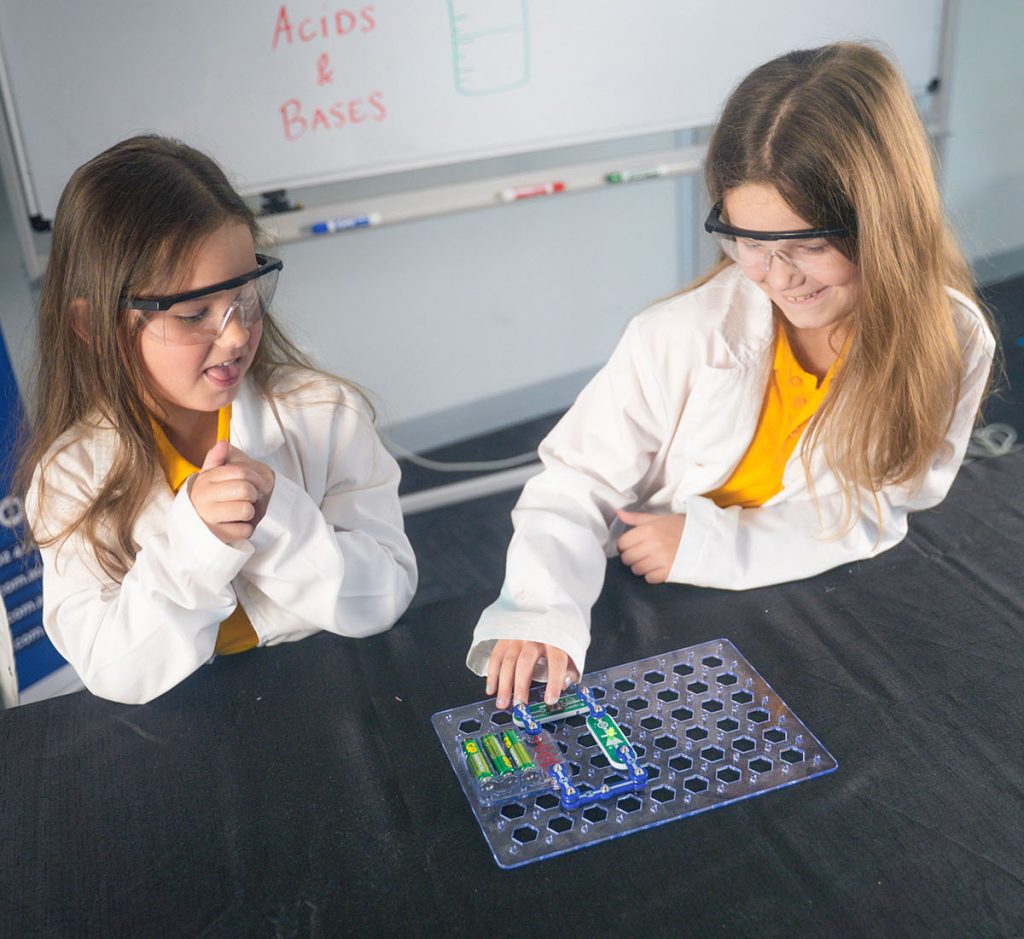
Build, test, and play with electricity. Using Snap Circuits, students create working circuits with switches, LEDs, resistors, sounds, and spinning propellers—exploring how electrical components work together through hands-on experimentation.
Activities
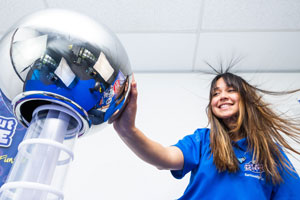
- Engaging demonstrations of static electricity.
- Whole-class activity to demonstrate the concept of an electrical circuit, and how a switch can be used to join or break a circuit.
- In pairs, students build simple circuits, creating series and parallel circuits and discussing the differences between them.
- In pairs, students build a circuit to power a propeller with a motor, identifying the energy transformations that take place and exploring the effect of reversing the wiring.
- Students use critical thinking skills to troubleshoot problems with their circuits.
- Students use Snap Circuits kits to build a variety of circuits with switches, lamps, motors, speakers, LEDs, and fans, applying the concepts they have learned.
- Demonstration of a solar cell, and discussion of the benefits of using renewable energy sources.
90 minute workshops also include these activities:
- Demonstration of an electromagnet and how a simple electric motor works.
- Students test a variety of materials and record them as conductors or insulators.
- Graphical representations of an electrical circuit, or circuit schematics, are introduced.
- Students build more complex circuits using the Snap Circuits components.
Learning Outcomes
- Understand that electricity is a form of energy essential to modern life.
- Explore how other forms of energy, such as solar, wind, coal and gas, are transformed into electrical energy in power plants.
- Identify the two types of electricity: static electricity and current electricity.
- Understand that an electrical current is the movement of electric charges around a closed loop called a circuit, and that switches control circuits by joining and breaking them.
- Recognise that as electricity moves through a circuit, energy is transformed into other forms such as light, heat or sound.
- Explore how electrical components can be connected in series or parallel circuits.
- Understand that electromagnets are magnets that can be switched on and off using electrical energy and are used in many everyday devices.
- Investigate how electric motors convert electrical energy into mechanical energy using electromagnets and magnetic forces.
- Understand that renewable energy sources such as solar generate electricity without producing carbon dioxide.
- Apply critical thinking and problem-solving skills when troubleshooting electrical circuits.
- Explore how different materials conduct electricity at different rates.
Victorian Curriculum Links
- Forces, including frictional, gravitational, electrostatic and magnetic, can be exerted by one object on another through direct contact or from a distance and affect the motion (speed and direction) of objects VC2S4U10
- Materials may be electrical insulators or conductors; energy can be transferred and transformed in electrical circuits where the components of a circuit play particular roles in the function of the circuit VC2S6U09
- Findings can be compared to those of others, including, as appropriate, whether a test was fair or not, to enable conclusions to be drawn, and may lead to the identification of further questions for investigation VC2S4I05
- Methods and findings can be compared with those of others to identify sources of error, to select evidence in support of reasoned explanations and conclusions, and to develop further questions for investigation VC2S6I05
NSW Curriculum Links
- Describes the characteristics and effects of common forms of energy, such as light and heat (ST2-8PW-ST)
- Describes how contact and non-contact forces affect an object’s motion (ST2-9PW-ST)
- Explains how energy is transformed from one form to another (ST3-8PW-ST)
- Investigates the effects of increasing or decreasing the strength of a specific contact or non-contact force (ST3-9PW-ST)
- Questions, plans and conducts scientific investigations, collects and summarises data and communicates using scientific representations (ST2-1WS-S)
- Plans and conducts scientific investigations to answer testable questions, and collects and summarises data to communicate conclusions (ST3-1WS-S)
Australian Curriculum Links
- Electrical energy can be transferred and transformed in electrical circuits and can be generated from a range of sources (ACSSU097)
- Participate in guided investigations, including making observations using the senses, to explore and answer questions (ACSIS025)
- With guidance, plan and conduct scientific investigations to find answers to questions, considering the safe use of appropriate materials and equipment (ACSIS054)