

Light Reflections
- Level: Year 3 to Year 6
- Duration: 60 or 90 minutes (90 minutes recommended)
- Numbers: Maximum of 30 students
- State: VIC
- Price
60 min: $450 per workshop
90 min: $560 per workshop
*Travel surcharge also applies based on location.
*Prices exclude GST.
*There is a minimum booking of 3 x 60 minute workshops or 2 x 90 minute workshops on the same day – or their cost equivalent.
"*" indicates required fields
Take an in-depth look at the properties of light, from what we can see to what we can’t. Students use a range of optical instruments to investigate reflection, refraction, and colour, explore ultraviolet light, and put their learning into practice by making a UV detection keychain to keep.
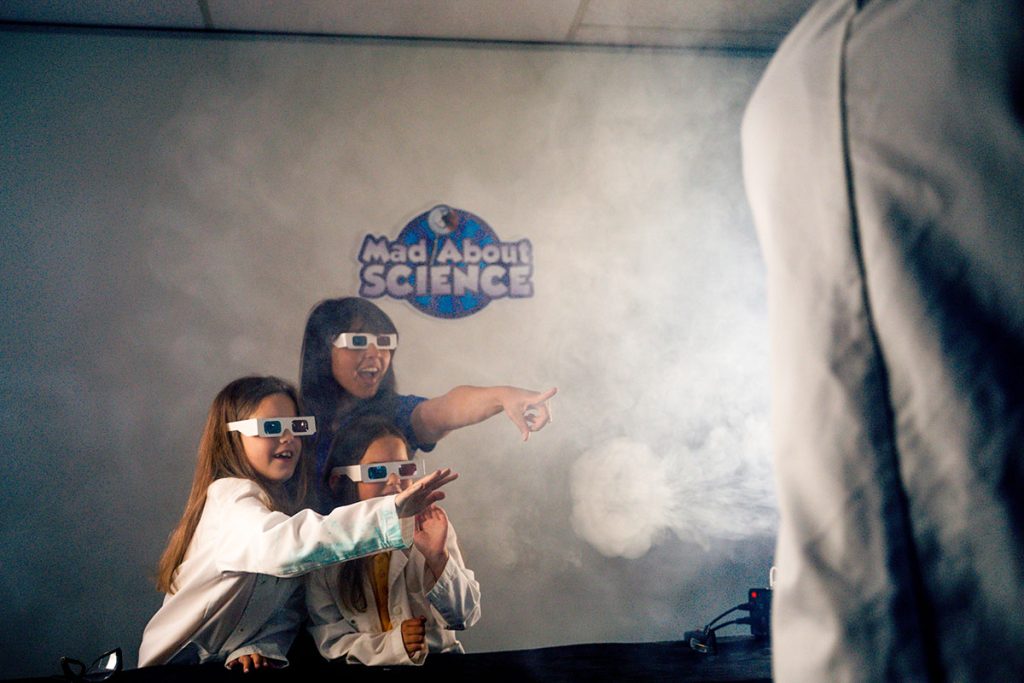
Activities
- Students explore the reflection and refraction of light using mirrors, lenses, and prisms with a light box.
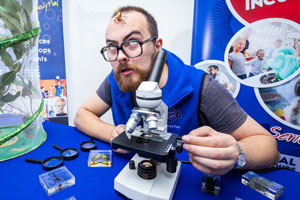
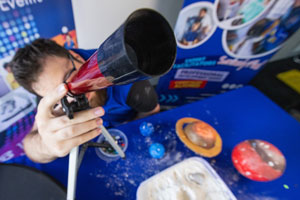
- Students explore a range of optical instruments and lenses, including a microscope, telescope, Fresnel lens, praxinoscope, and periscope.
- Students observe how the primary colours of light are mixed to form other colours.
- Students construct an electrical circuit to light up a bulb, then experiment to find different ways of lighting two bulbs.
- Students create a whole-class human circuit to light up LEDs.
- Demonstration of how light energy can be transformed into other types of energy, such as electrical energy.
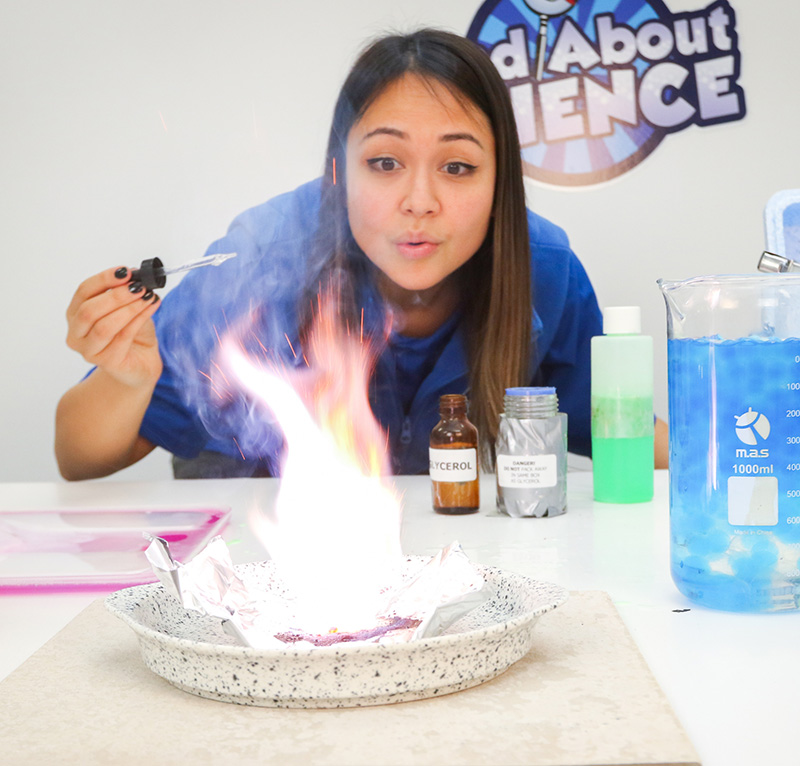
- Students observe chemiluminescence.
90 minute workshops also include these activities:
- Students use UV light to cause a colour change.
- Each student constructs a UV light detector keychain to keep.
Learning Outcomes
- Understand that light is a form of energy that travels in waves and moves faster than anything else in the Universe.
- Recognise that light is essential for vision and for growing plants used as food.
- Explore how light enters the eye through the pupil, forms an image on the retina, and is transmitted to the brain.
- Understand that light travels in rays and reflects off smooth, shiny surfaces such as mirrors.
- Investigate how flat (plane), concave and convex mirrors reflect light in different ways.
- Explore refraction, where lenses bend light to focus rays at a point, and how lenses are used in optical instruments such as glasses, microscopes and telescopes.
- Understand that white light is a mixture of colours and that prisms split white light into the visible spectrum.
- Identify the three primary colours of light—red, green and blue—and explore how they combine to make other colours.
- Investigate how objects absorb and reflect different colours of light, producing the colours we see.
- Compare transparent, translucent and opaque materials, and understand how opaque objects cast shadows.
- Explore how light energy can be transformed into other forms of energy such as electrical or chemical energy (photosynthesis).
- Understand how electricity can be used to produce light using a complete electrical circuit.
- Investigate light produced by chemical reactions, including chemiluminescence and bioluminescence.
- Explore ultraviolet (UV) light and how some materials emit visible light when exposed to UV radiation.
Victorian Curriculum Links
- Light can be produced from many sources; light travels in a straight path, can form shadows, and can be absorbed, transmitted, reflected or refracted by objects VC2S6U08
- Materials may be electrical insulators or conductors; energy can be transferred and transformed in electrical circuits where the components of a circuit play particular roles in the function of the circuit VC2S6U09
- Heat energy can be generated from different sources; temperature changes may happen when heat is transferred from one object to another VC2S4U09
NSW Curriculum Links
- Describes the characteristics and effects of common forms of energy, such as light and heat (ST2-8PW-ST)
- Plans and uses materials, tools and equipment to develop solutions for a need or opportunity (ST3-2DP-T)
- Describes common forms of energy and explores some characteristics of sound energy (ST1-8PW-S)
- Investigates how forces and energy are used in products (ST1-9PW-ST)
- Explains how the properties of materials determine their use for a range of purposes (ST3-7MW-T)
Australian Curriculum Links
- Light from a source forms shadows and can be absorbed, reflected and refracted (ACSSU080)
- Electrical energy can be transferred and transformed in electrical circuits and can be generated from a range of sources (ACSSU097)
- Analyse ways to produce designed solutions through selecting and combining characteristics and properties of materials, systems, components, tools and equipment (ACTDEK034)